DHT 11 Uplink Data and Downlink Data displayed on OLED
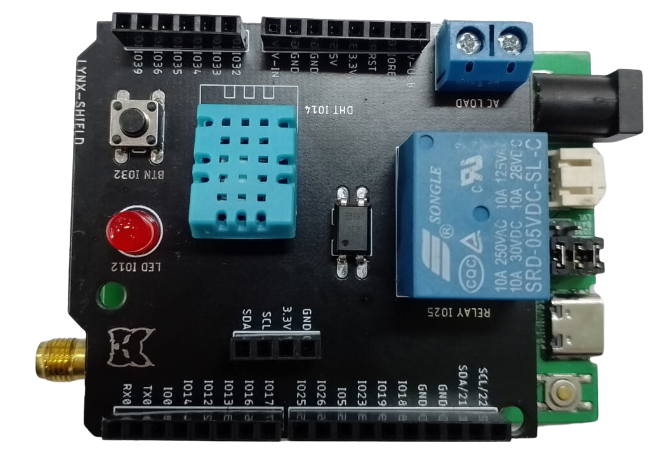
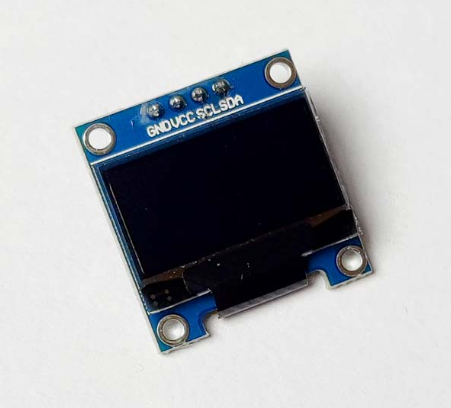
In this project, you will use the Antares Workshop Shield on the Lynx-32 Antares Development Board module. The Antares Workshop Shield contains temperature, humidity (DHT11) sensors, relays, LEDs and push buttons. You will send DHT11 data and can give downlink messages displayed on the OLED display. The process of sending this downlink uses POSTMAN software which performs a HIT API downlink to the Antares Platform.
Image of Development Board Lynx-32 and Shield Workshop Antares.
Prerequisites
The required materials follow the General Prerequisites on the previous page. If you have not prepared the requirements on that page, then you can visit the following page.
You can open the programme code in the Arduino IDE via File > Examples > Antares LoRaWAN > Lynx32-Simple-Project > Class A > UPLINK_DOWNLINK_DHT11_OLED_CLASS_A.
Here is the programme code of the UPLINK_DOWNLINK_DHT11_OLED_CLASS_A example.
You can open the programme code in the Arduino IDE via File > Examples > Antares LoRaWAN > Lynx32-Simple-Project > Class C > UPLINK_DOWNLINK_DHT11_OLED_CLASS_C
Here is the programme code of the UPLINK_DOWNLINK_DHT11_OLED_CLASS_C example.
3. Set LoRaWAN Parameters in Antares
On the Antares Device console page, set the LoRa by pressing the Set LoRa button as shown below.
Image of the Antares Console Page for LoRa Set.
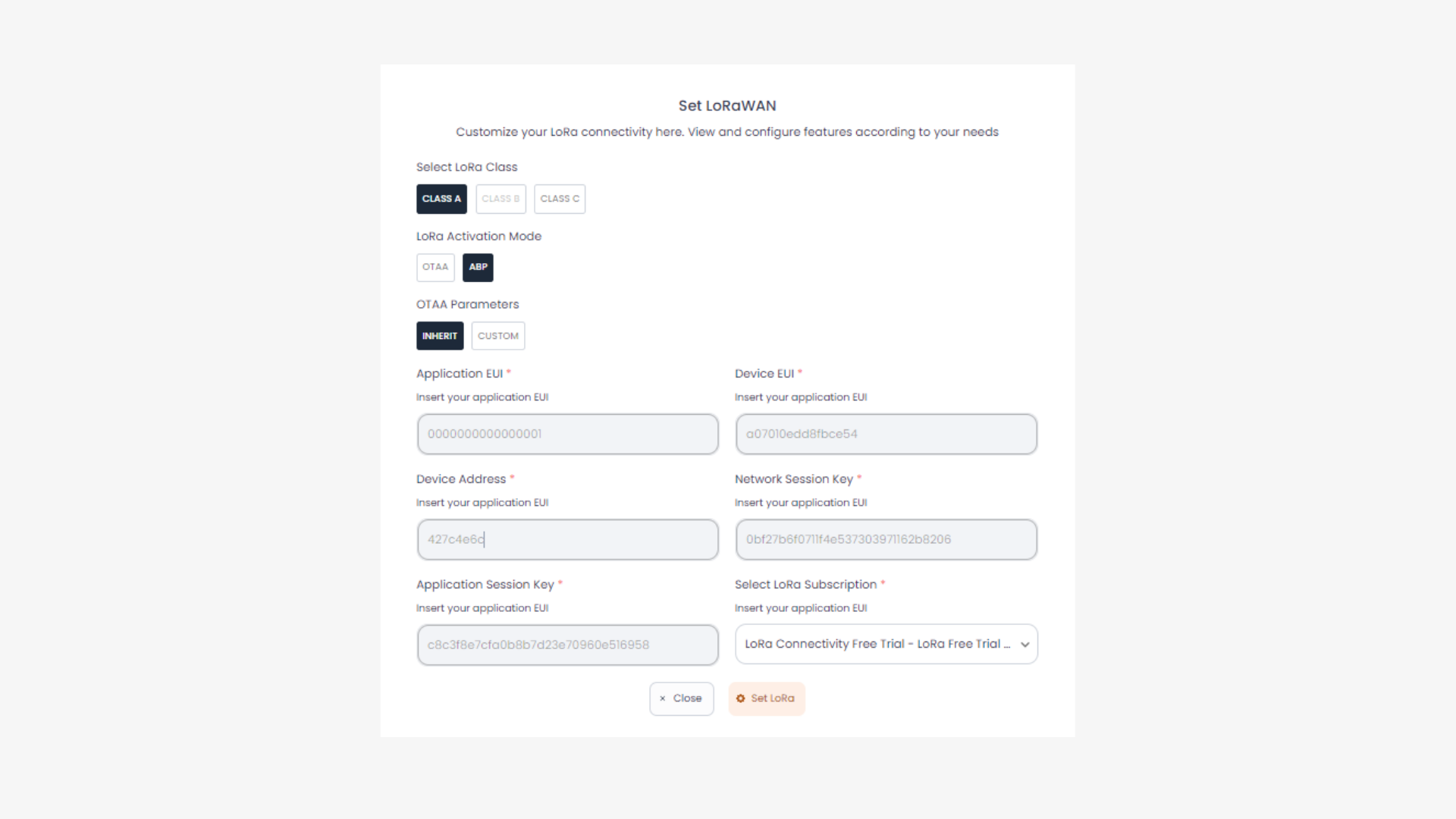
Input LoRaWAN parameters with Lora Device Class A, Activation Mode ABP, ABP Parameters Inherit as shown below.
When selecting ABP Parameters Inherit, the LoRa parameters will be generated by Antares. From the device side, the Lynx32 Development Board needs to adjust the LoRa parameters.
Don't forget to save (copy) the Network Session Key and Application Session Key parameters before clicking Set LoRa to facilitate the next process.
The Form image contains the LoRa Class A Parameter Set.
Make sure your antares account has an active LoRa package.
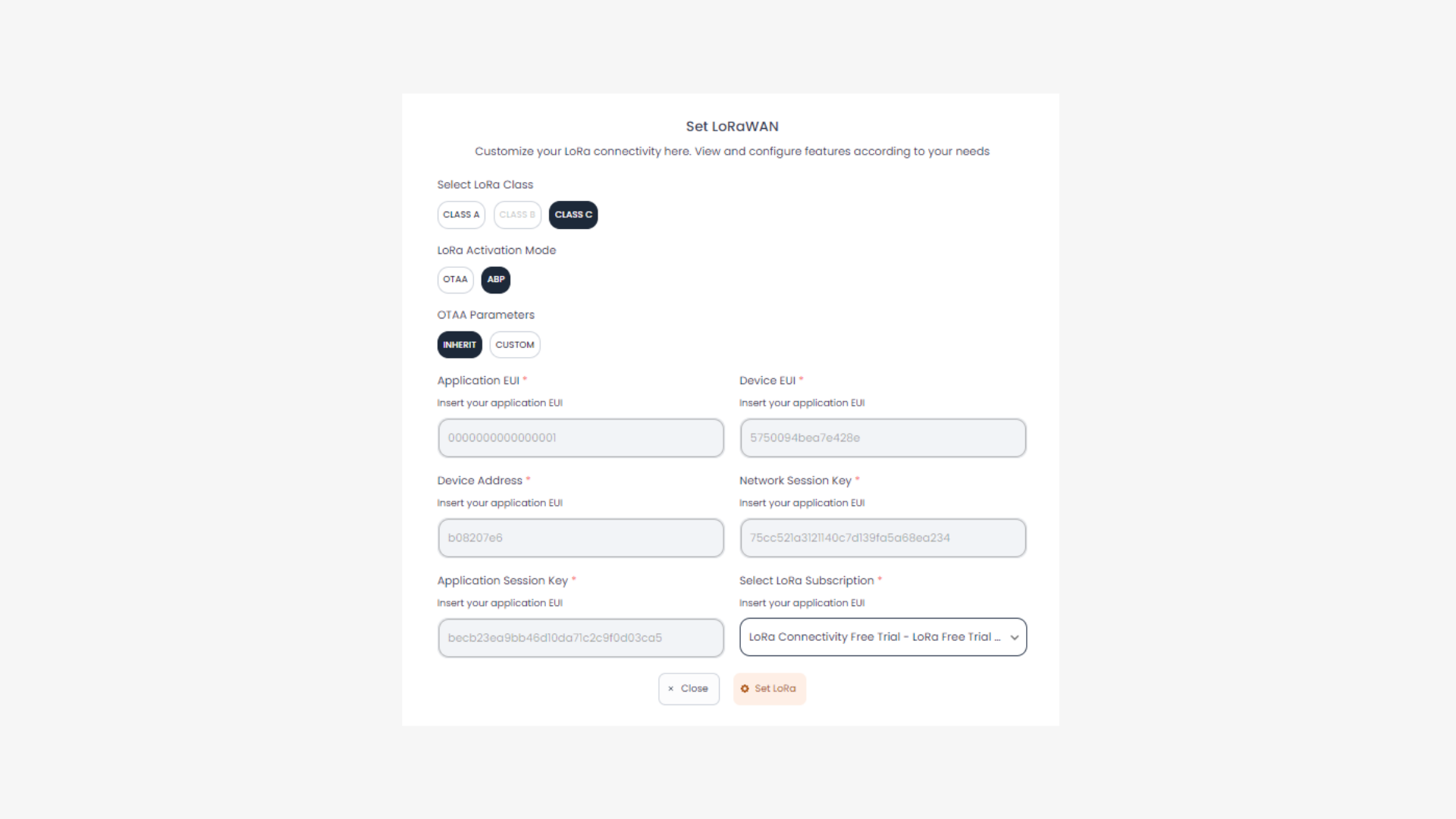
Input LoRaWAN parameters with Lora Device Class C, Activation Mode ABP, ABP Parameters Inherit as shown below.
When selecting ABP Parameters Inherit, the LoRa parameters will be generated by Antares. From the device side, the Lynx32 Development Board needs to adjust the LoRa parameters.
Don't forget to save (copy) the Network Session Key and Application Session Key parameters before clicking Set LoRa to facilitate the next process.
The Form image contains the LoRa Class C Parameter Set.
Make sure your antares account has an active LoRa package.
4. Set LoRaWAN Parameters in Programme Code
Change the LoRaWAN ABP parameters in the following variables *devAddr , *nwkSkey and *appSKey. Adjust to the parameters in the Antares console.
The *devAddr parameter that has been generated by Antares can be seen on the device page after completing the LoRa Set.
The parameters *nwkSKey and *appSKey are obtained during Set LoRa in the previous step.
Figure Antares Console Page After successful LoRa Set
Jika anda lupa menyimpan *nwkSkey dan *appSKey pada langkah sebelumnya maka lihat accesskey pada akun antares anda kemudian ikuti format berikut.
5. Compile and Upload Program
Connect the Lynx-32 Development Board to your computer and make sure the Communication Port is read.
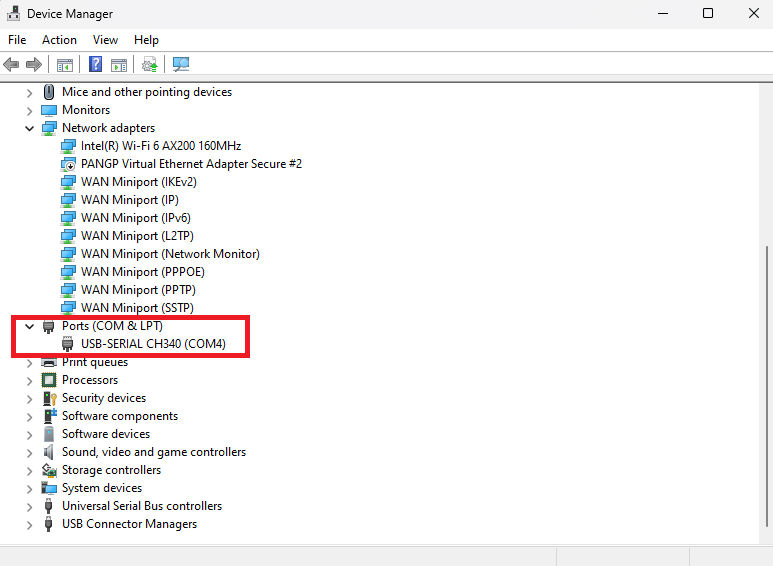
On Windows operating systems the check can be done via Device Manager. If your Lynx-32 Development Board is read, the USB-Serial CH340 will appear with the port adjusting the port availability (in this case it reads COM4).
Device Manager image on Windows.
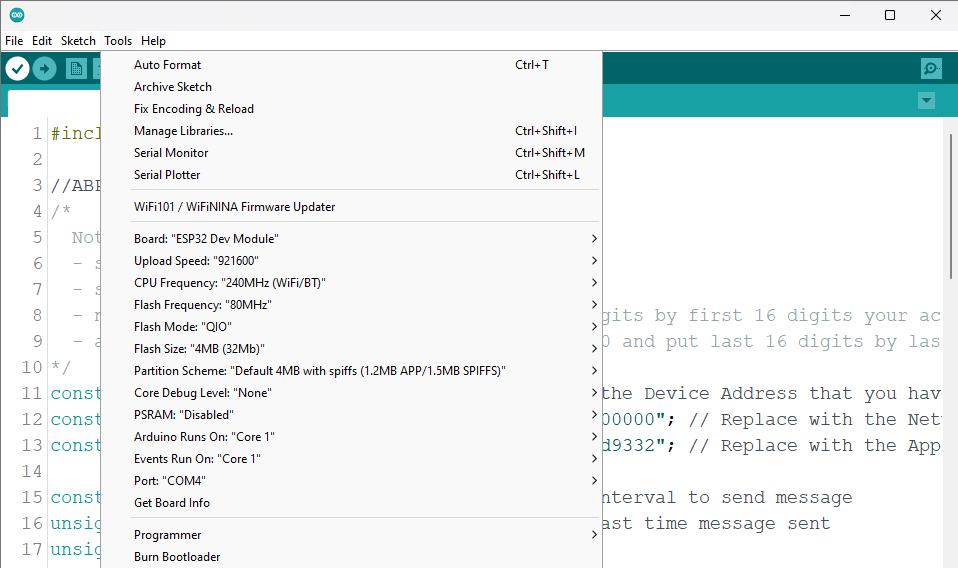
Set up the Lynx-32 Board by clicking Tools > Board > ESP32 Arduino in the Arduino IDE, then make sure the board used is the ESP32 Dev Module. Select the port according to the communicaion port that is read (in this case COM4). The result will look like the following picture.
Image of the Tools Menu in the Arduino IDE.
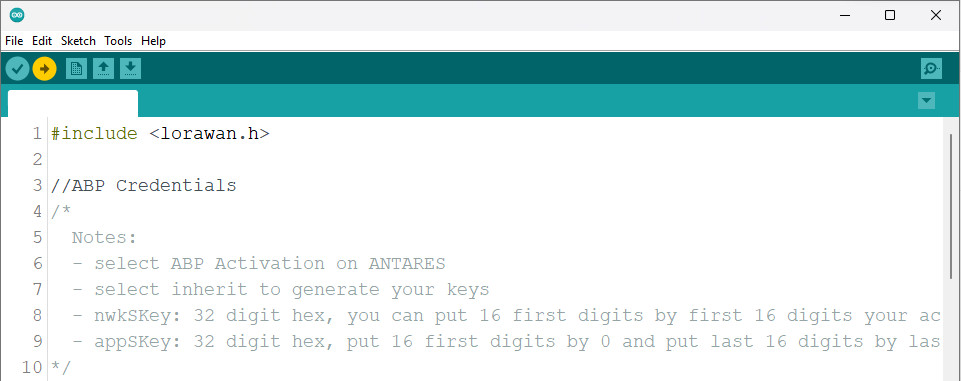
After all the setup is complete, upload the programme by pressing the arrow icon as shown below. Wait for the compile and upload process to finish.
Image of the Verify and Upload Icon in the Arduino IDE.
The Tick icon on the Arduino IDE is just the verify process. Usually used to Compile the programme to find out whether there are errors or not.
The Arrow icon on the Arduino IDE is the verify and upload process. Usually used to Compile the programme as well as Flash the programme to the target board.
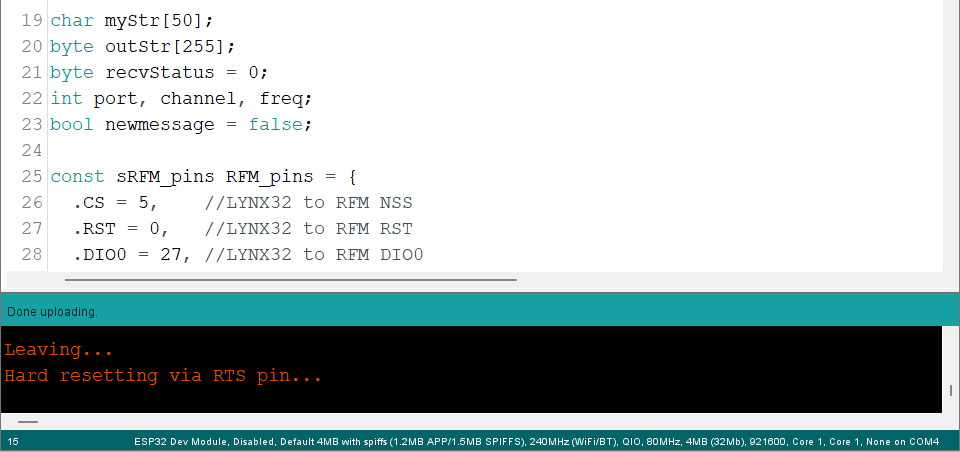
If the programme upload is successful, it will look like the following image.
Arduino IDE page image after successful upload.

After uploading the programme, you can view the serial monitor to debug the programme. The serial monitor icon is shown in the following image.
Image of the Serial Monitor Icon in the Arduino IDE.
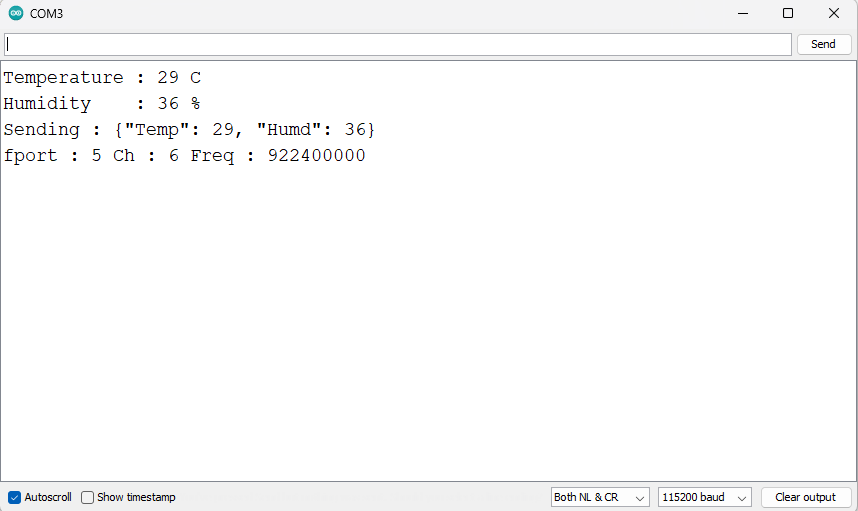
Set the serial baud rate to 115200 and select BothNL & CR. The result will look like the following image.
Serial Monitor Display
Make sure the serial baud rate matches the value defined in the programme code. If the serial baud rate is not the same between the programme code and the serial monitor, the ASCII characters will not be read properly.
6. Setup software POSTMAN
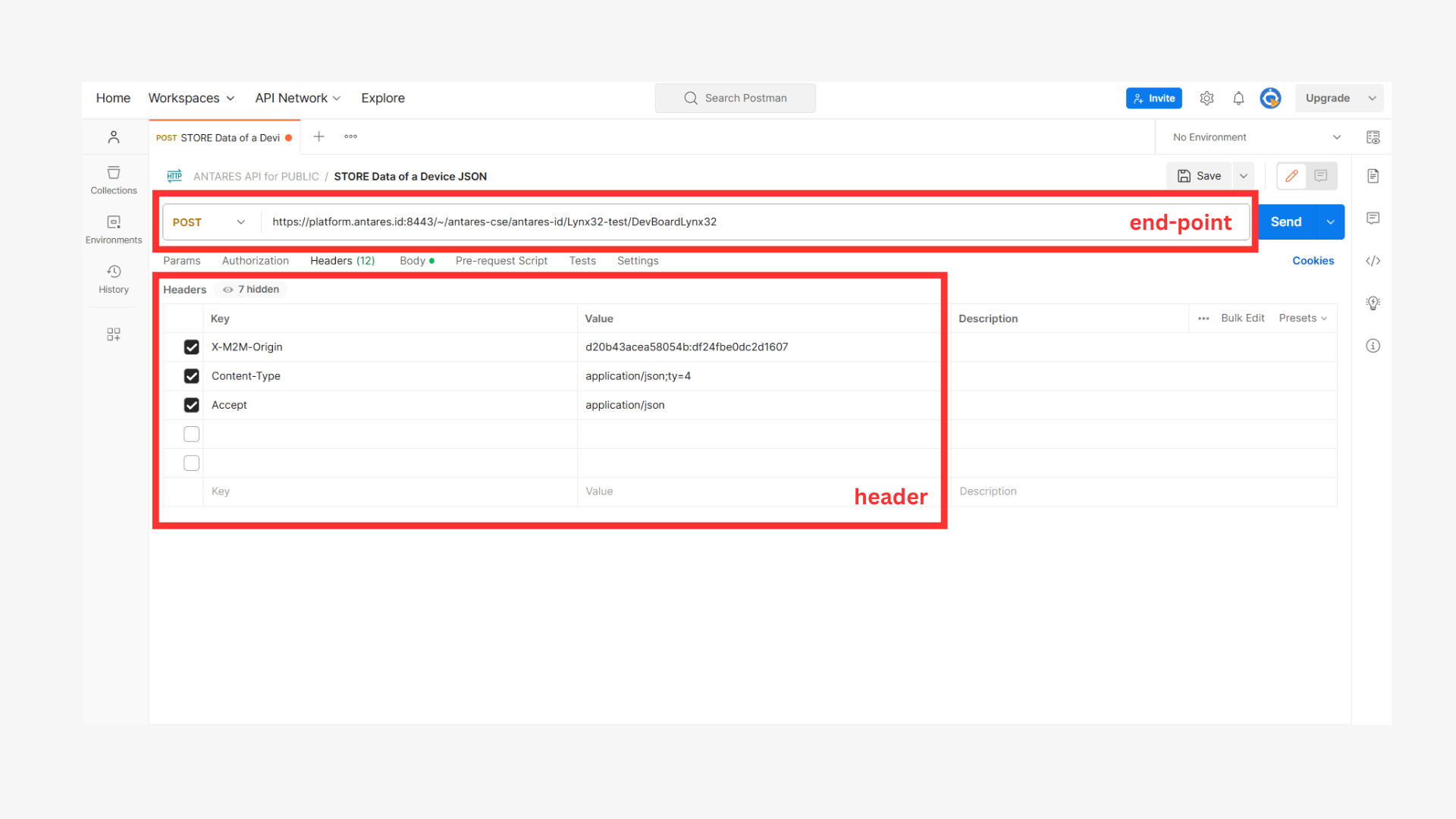
In this step, you need POSTMAN software. You can input the end-point, request header, and request body first by following the following format.
Customise your-application-name and your-device-name to the names registered to your Antares account.
Request Header
Key
Value
X-M2M-Origin
your-access-key
Content-Type
application/json;ty=4
Accept
application/json
Customise your-access-key with your Antares account access key.
The result is as shown in the following image.
Image of end-point and header settings in POSTMAN software.
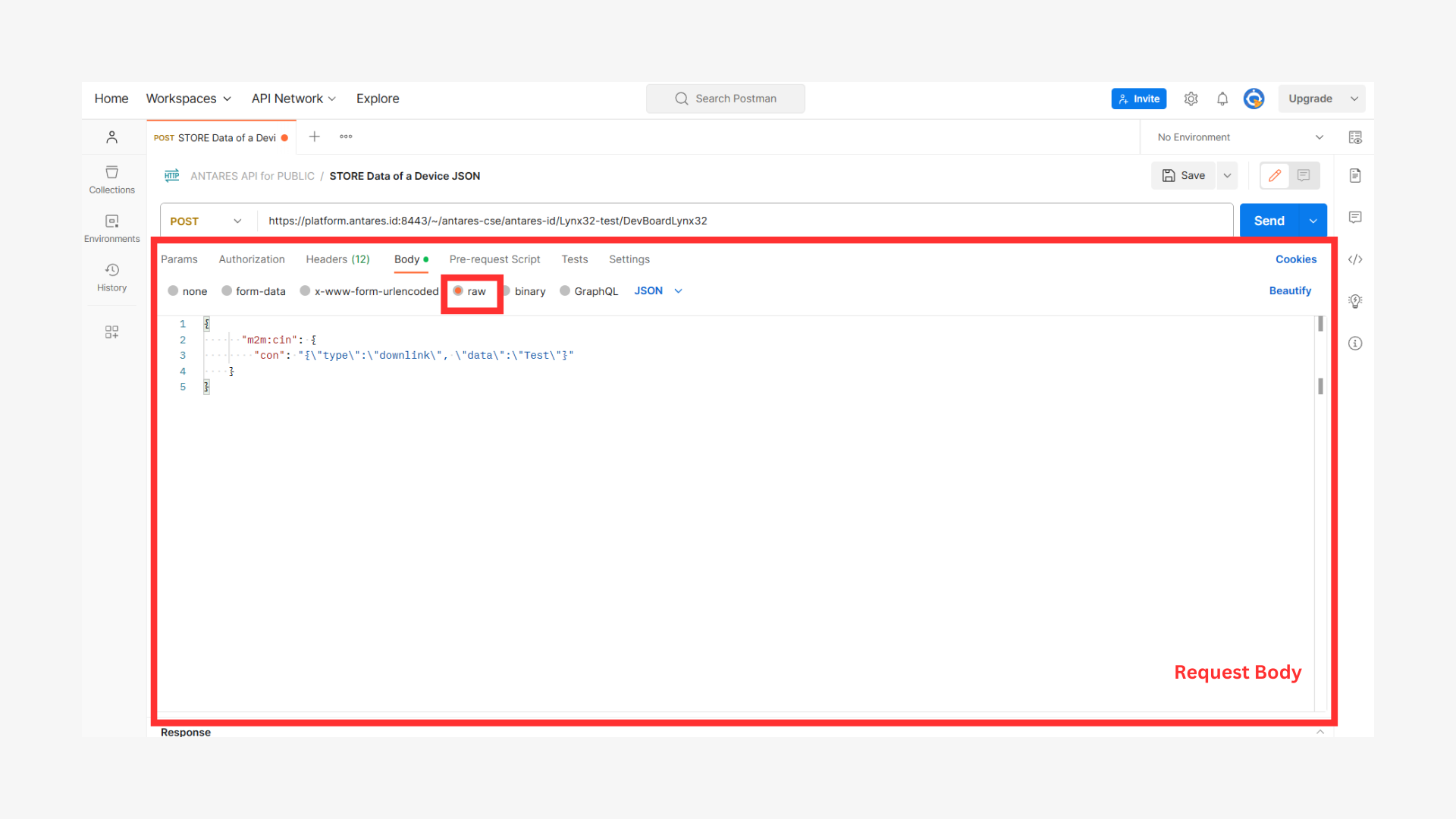
Next you need to input the request body to follow the following format.
Request Body
Default Downlink Port is port 10.
If you are using a Custom Downlink Port then fill the "fport" field with an integer number other than 0.
In the POSTMAN software, select the Body tab then select raw and enter the payload according to the request body you want to use as shown below.
Image of the contents of the payload request body in the POSTMAN software.
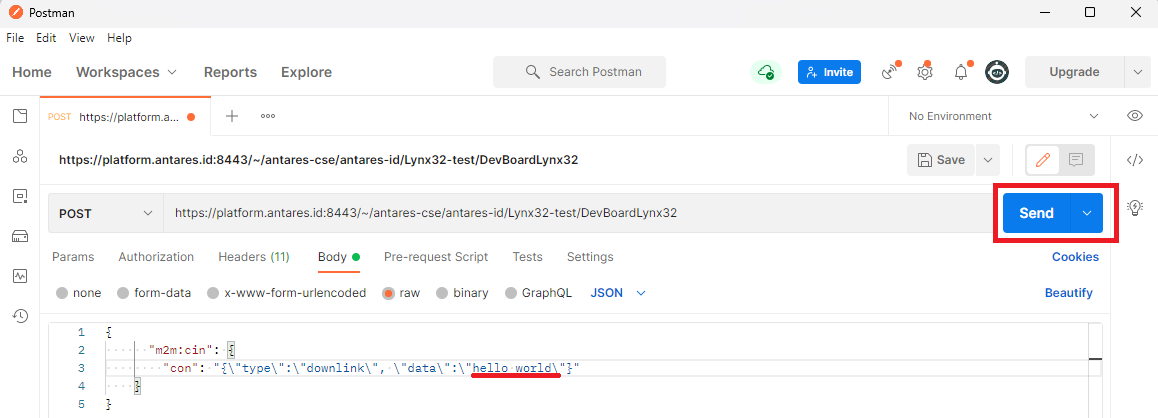
Customise the contents of the "data" field according to the downlink command you want to send.
7. Sending Downlink Messages
After the POSTMAN software setup is complete, it's time to send the downlink command. In the "data" field, fill in the string "hello world" as the message to be sent via the downlink lorawan. If you have finished filling in the "data" field, then press the Send button on the POSTMAN software.
Gambar isi payload request body pada software POSTMAN.
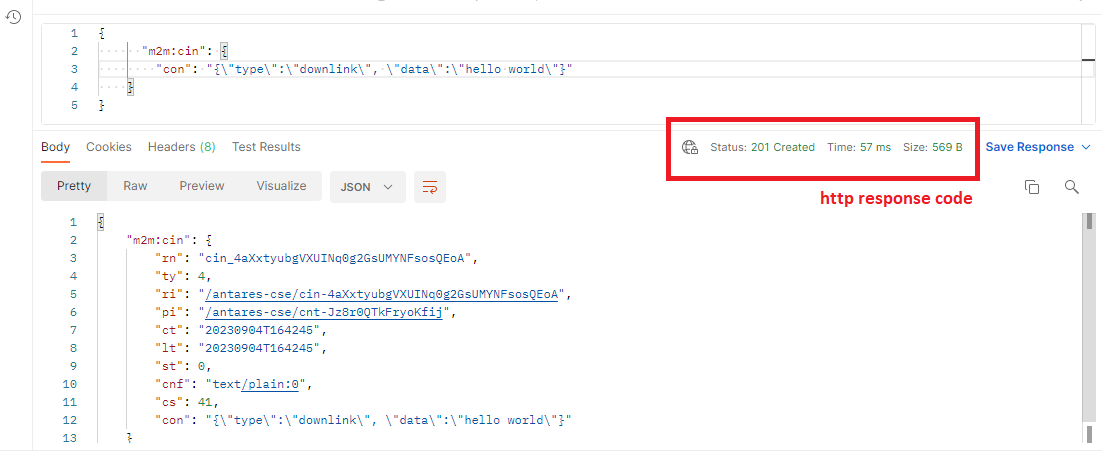
If the HTTP request through POSTMAN software is successful, the POSTMAN software response section will display a message as shown below.
Jika permintaan HTTP melalui perangkat lunak POSTMAN berhasil, bagian respons perangkat lunak POSTMAN akan menampilkan pesan seperti yang ditunjukkan di bawah ini.
8. Check Data in Antares
After the step of sending the downlink message in the POSTMAN software is successful, then open the Antares device page and see if the downlink command has entered Antares.
The data sent from POSTMAN is in the form of "type": "downlink" and "data". The downlink message passed to the Lynx-32 Development Board is in the "data" field.
9. View Downlink Messages
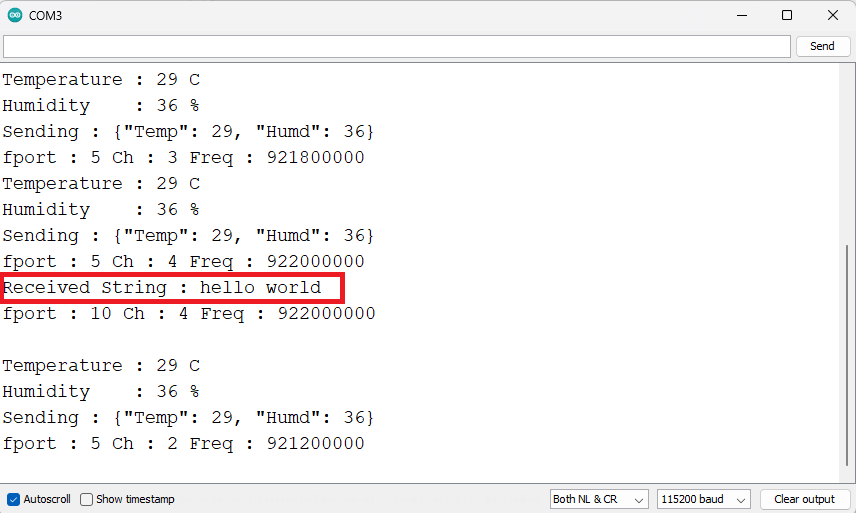
The downlink messages forwarded from Antares to the Lynx-32 Development Board can be seen in the Serial Monitor as shown below.
In LoRaWAN Class A, the downlink message will be received by Lynx-32 after Lynx-32 performs an uplink.
In LoRaWAN Class C, downlink messages will be received by Lynx-32 at any time.
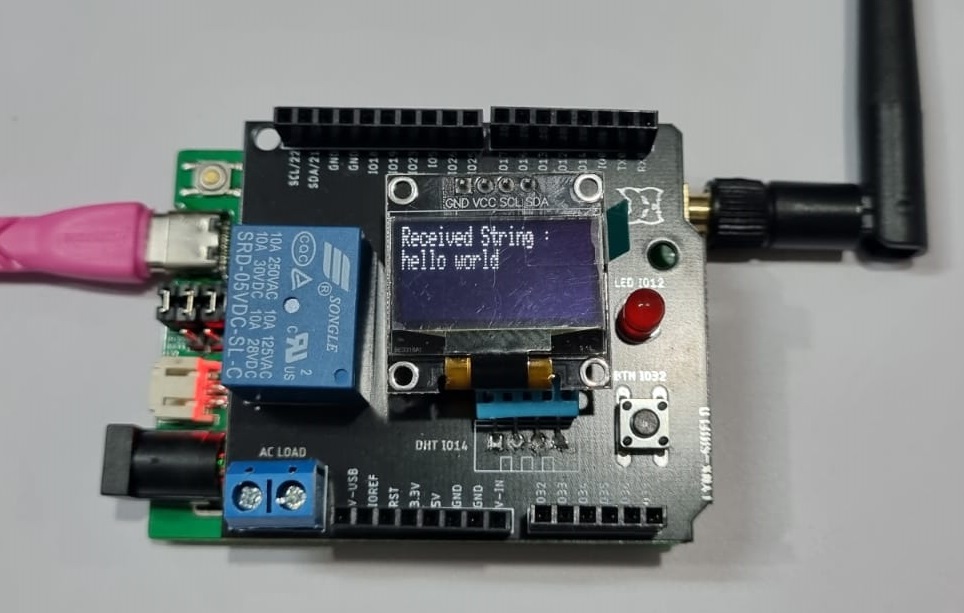
The received downlink message is also displayed on the OLED as shown below.
Image of the downlink message displayed on the OLED display.
Example Accesskey = "aaaaaaaaaaaaaaaa:bbbbbbbbbbbbbbbb"; //32 digit accesskey
const char *nwkSKey = "aaaaaaaaaaaaaaaa0000000000000000"; //16 digit first accesskey plus 16 digit zero
const char *appSKey = "0000000000000000bbbbbbbbbbbbbbbb"; //16 digit zero plus 16 digit last acesskey