> For the complete documentation index, see [llms.txt](https://docs.antares.id/llms.txt). Markdown versions of documentation pages are available by appending `.md` to page URLs; this page is available as [Markdown](https://docs.antares.id/en/getting-started/arduino-library-installation/antares-wi-fi-http.md).
# Antares Wi-Fi HTTP
In this documentation you will be explained how to install the Antares ESP library with HTTP protocol and Wi-Fi connectivity on the Arduino IDE. This library is used to test the ESP32 Wi-Fi HTTP project in the Antares documentation. This library is suitable for **ESP32** and **ESP8266**.
## Follow These Steps
### 1. Download Library
The first step is to download the following library in .zip format.
{% file src="/files/LnyrYr62WjYXairbpsG2" %}
{% hint style="warning" %}
Notes: The above library can be used for ESP 32 and ESP 8266 using Wi-Fi communication and HTTP communication protocol..
{% endhint %}
### 2. Installing Zip Library
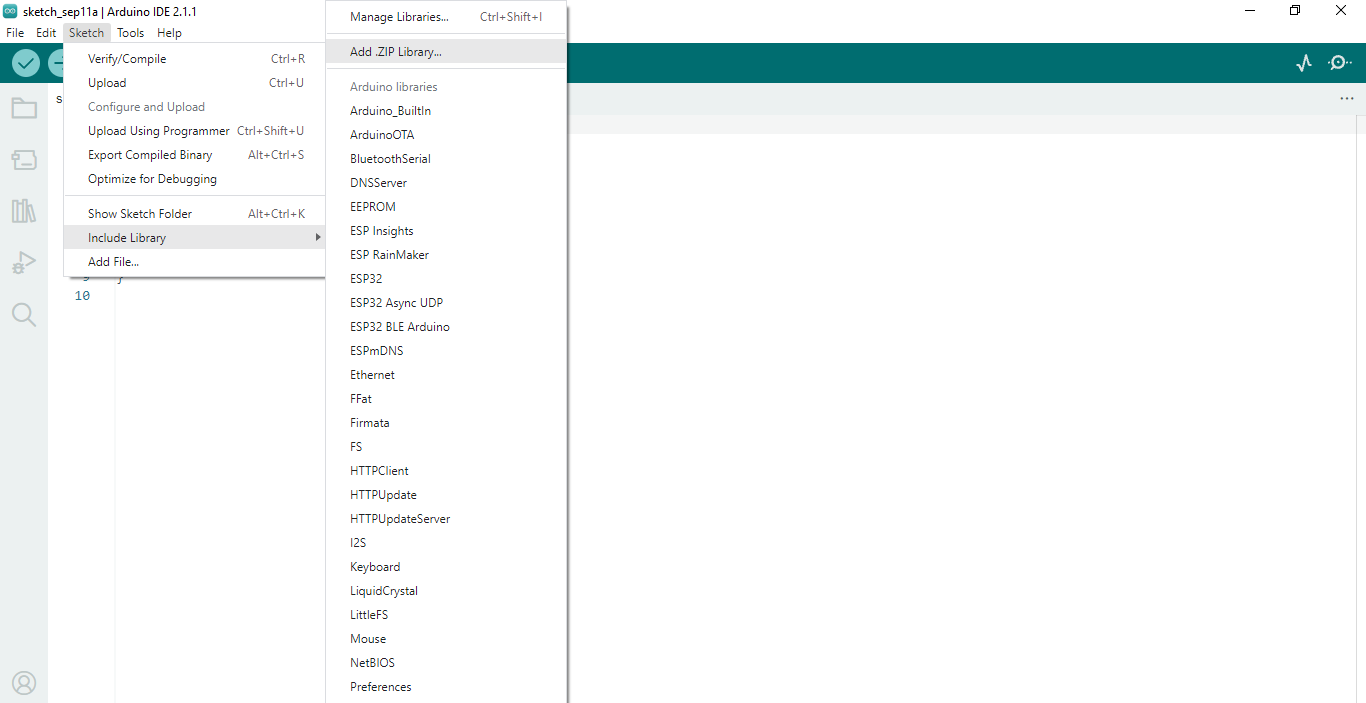
In this step you are asked to open the library manager by opening the **Sketch menu> Include Library> Add .Zip Library** as shown in the following image.
Image of the Sketch menu in the Arduino IDE.
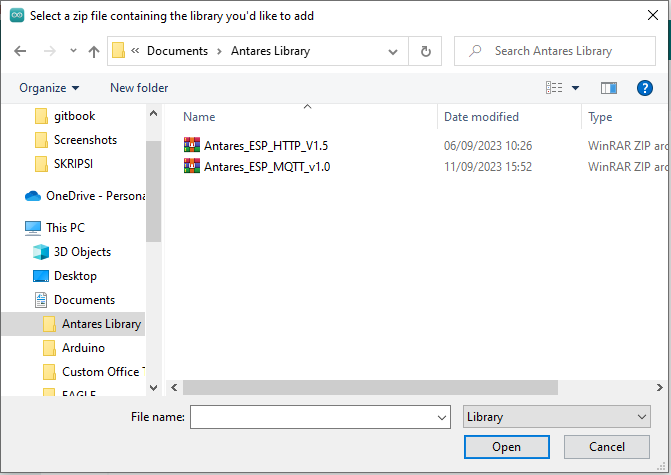
Find the location of the library file that has been downloaded, then input the downloaded file as shown below.
Image Select Zip File in the Arduino IDE.
### 3. Success Indicators
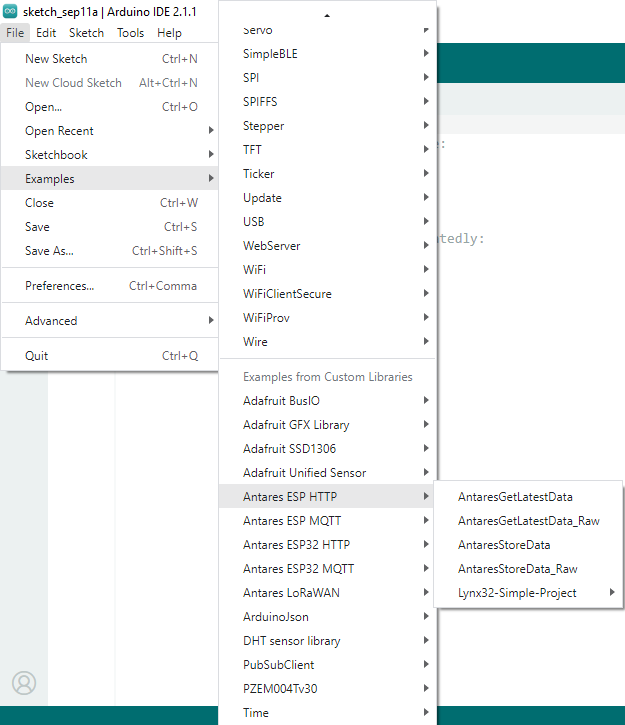
If the library installation is successful, you can see the example programme in the **File > Examples > Antares ESP HTTP menu.** The result looks like the following image.
Figure Example of Antares ESP HTTP and MQTT in the Arduino IDE.